


FINAL FANTASY RESONANCE


Starting your adventure in Final Fantasy Resonance is easier when you understand how its turn-based combat, Vision system, and exploration mechanics work together. Developed with classic RPG elements and modern HD-2D visuals, the game combines familiar Final Fantasy features with strategic systems that reward careful planning. Whether you are starting the free demo or beginning the full game, this beginner’s guide covers the essential mechanics, useful early-game strategies, and common mistakes to avoid. If you want to explore available account options before diving into the adventure, you can also Buy Final Fantasy Resonance Account and find an option that suits your gaming preferences.

Understand the Basics Before Starting Your Adventure
Final Fantasy Resonance features command-based battles, an evolving job system, collectible Visions, and powerful summons known as Espers. You control a party of characters as they explore the world, complete quests, and fight enemies.
The official website highlights several core features:
Turn-based combat: Choose commands based on the battle situation rather than relying on real-time attacks.
An evolved job system: Characters have different roles and abilities that influence party composition.
The Vision system: Equip crystallized essences of legendary heroes to gain additional powers.
Resonance attacks: Trigger powerful special moves by meeting specific battle conditions.
Espers: Summon powerful allies to assist your party during combat.
The free demo covers the opening chapter, offering approximately three to five hours of gameplay. According to Square Enix, demo save data can be transferred to the full game, making it a useful way to learn the mechanics before continuing your adventure.
Learn How the Battle Timeline Works
One of the most important things beginners should understand is the battle timeline.The timeline at the top of the battle screen shows the upcoming action order for allies and enemies. Characters act according to this order, so checking it before selecting a command helps you anticipate incoming attacks and plan your next move.Instead of automatically choosing the strongest available attack, consider the following questions:
Which enemy will act next?
Can you stagger that enemy before its turn?
Does an ally need healing or protection?
Can your party exploit an elemental weakness?
Will a defensive action prevent more damage than an immediate attack?
For example, if a dangerous enemy is about to act, reducing its stagger gauge may be more valuable than dealing slightly more damage with an ordinary attack.This approach is particularly useful against bosses, where controlling enemy actions can make a significant difference.
Exploit Elemental Weaknesses and the Stagger System
Elemental weaknesses are central to combat strategy. Enemies can take increased damage from specific elements, so identifying the correct attack is often more effective than repeatedly using the same powerful skill.The stagger gauge, displayed beneath an enemy’s HP bar, is equally important. Reducing this gauge to zero staggers the target, preventing it from acting on its turn and lowering its defense.
How to Use Stagger Effectively?
Check enemy weaknesses. Use available information or suitable abilities to identify effective elements.
Choose attacks carefully. Prioritize skills that exploit weaknesses or contribute meaningfully to the stagger gauge.
Watch the timeline. Try to stagger dangerous enemies before they can perform their next action.
Prepare for the bonus phase. A successful stagger can grant an additional action at the end of the round.
Aim for a sweeping stagger. Staggering every enemy in a single turn grants the party an extra action during the bonus phase and enables a Resonance attack at its conclusion.
Resonance attacks are not simply stronger versions of ordinary attacks. Depending on the equipped Vision, they can provide powerful area damage or additional effects.The most reliable beginner strategy is to combine weakness exploitation with timeline awareness. Damage matters, but controlling the pace of battle can be just as important.
Build Your Party Around Visions
Visions represent the crystallized essences of legendary heroes and provide characters with additional abilities. They are also central to character progression.According to the official gameplay explanation, players obtain Visions through story-related events and can unlock further abilities by fighting with them equipped.As you progress, you should focus on building a balanced combination of abilities rather than equipping everything around raw damage.
| Party requirement | What to prioritize | Why it helps |
|---|---|---|
| Damage dealing | Effective offensive skills and elemental coverage | Helps defeat enemies efficiently |
| Staggering | Abilities suited to reducing enemy stagger gauges | Creates opportunities for extra actions |
| Healing | Reliable recovery skills | Keeps the party ready for longer encounters |
| Defense | Protection, defensive buffs, or enemy-targeting control where available | Reduces the risk of losing key party members |
| Utility | Status protection, analysis, and other situational abilities | Makes unfamiliar encounters easier to manage |
Practical Vision Tips
Fight with equipped Visions to earn Mastery Points (MRP) and develop their abilities.
Check newly unlocked abilities instead of assuming that every learned skill is automatically available.
Pay attention to ability costs and the combinations you can equip.
Experiment with different setups when a boss repeatedly defeats your party.
Consider the next encounter when deciding which Vision and abilities to use.
One useful feature is that learned abilities can remain available when switching to another Vision, provided the relevant ability cost limit is respected. This allows you to combine abilities from different Visions and create more flexible builds.For instance, a character can focus on staggering enemies while benefiting from useful abilities learned through another Vision. The exact combination will depend on the abilities you have unlocked and the cost limits of your current setup.
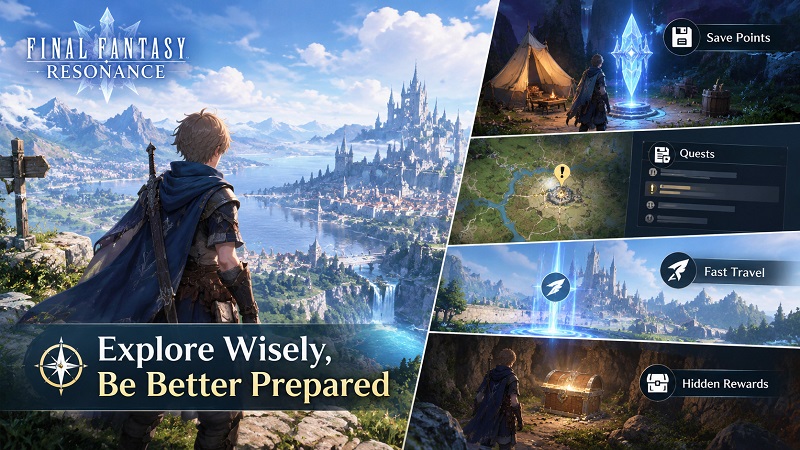
Explore Carefully and Make Use of Save Points
Exploration is more than travelling between story locations. Towns, dungeons, quests, and optional encounters can provide valuable opportunities to prepare your party.Save points are particularly important. The game's tutorial explains that they allow you to save progress, while using a Tent at a save point fully restores the HP and MP of all party members.
Keep these exploration habits in mind:
Save regularly. Record your progress before difficult encounters or unfamiliar areas.
Use Tents strategically. Restore the entire party before a challenging fight when necessary.
Track side quests. Accept quests from marked NPCs and use the quest menu to follow objectives.
Check the map. The world map helps you identify your current location and destination.
Use fast travel when available. Previously visited locations can be reached through the map menu, although some areas have restrictions.
Look for optional rewards. Explore side paths and check available treasure chests rather than rushing through every location.
These habits help reduce unnecessary backtracking and ensure that you do not enter a major battle with depleted resources.
Prepare for Boss Battles Instead of Relying on Raw Damage
Bosses often require more planning than ordinary enemies. Their weaknesses, status effects, supporting enemies, and attack patterns can change the best approach.
Before a major encounter, review the following checklist:
Check your party's HP and MP.
Equip abilities that complement your current party roles.
Review available elemental attacks.
Prepare healing and status-protection options where appropriate.
Watch the timeline for dangerous upcoming actions.
Save before entering the encounter when possible.
Reconsider your Vision setup if your current strategy repeatedly fails.
A boss that inflicts status ailments may require a different approach from one that deals heavy physical damage. Similarly, an encounter with multiple enemies may reward area attacks or sweeping staggers, while a single powerful target may be easier to manage through focused damage and stagger control.If a fight becomes difficult, first review your abilities, equipment, and tactics. Repeating the same actions without adapting to the enemy's mechanics is rarely the most efficient approach.
Common Beginner Mistakes to Avoid
Even players familiar with traditional turn-based RPGs can overlook some of Resonance's mechanics.
| Common mistake | Better approach |
|---|---|
| Ignoring the battle timeline | Check upcoming actions before choosing commands |
| Using the same element against every enemy | Identify weaknesses and adjust your attacks |
| Focusing exclusively on HP damage | Consider stagger pressure and opportunities for extra actions |
| Neglecting Vision progression | Develop useful abilities and review equipment regularly |
| Entering bosses without preparation | Save, restore resources, and adjust your party setup |
| Forgetting quests and exploration | Track objectives and investigate optional paths |
| Assuming learned abilities are always active | Check ability equipment and cost restrictions |
The key lesson is to treat combat as a system of connected decisions. Party composition, Vision abilities, enemy weaknesses, and turn order all influence one another.
Final Beginner Tips
If you want to make your first hours in Final Fantasy Resonance smoother, focus on these five priorities:
Learn to read the battle timeline.
Exploit elemental weaknesses and build stagger pressure.
Develop Visions and combine compatible abilities.
Save regularly and manage HP and MP before difficult encounters.
Adapt your party and strategy to each boss instead of relying on one setup.
You do not need to master every system immediately. Start with the fundamentals, experiment with different Vision combinations, and gradually expand your understanding of the game's combat mechanics.
For players who want a complete reference, Square Enix also lists an official Final Fantasy Resonance Complete Guide + Setting Materials book, covering story progression, maps, Vision development, recommended party combinations, enemy data, and boss strategies. Players looking for an affordable way to access the game can also explore Cheap Final Fantasy Resonance CD Key offers to find an option that fits their budget. With a better understanding of the timeline, stagger mechanics, Visions, and exploration tools, new players can approach the opening chapter with greater confidence and build a stronger foundation for the adventures ahead.









SUPPORT
LEGAL
Policies


 USD ($)
 English
 Help Center