


Getting Over It with Bennett Foddy

Embarking on the climb in Getting Over It is a unique test of patience and skill. For those daunted by starting from absolute zero, some consider a shortcut to begin the ordeal, such as the option to Buy Getting Over It with Bennett Foddy Account. Whether you start fresh or otherwise, understanding the journey ahead is crucial for that first successful summit.
What Challenges Will You Face on Your First Summit Attempt?
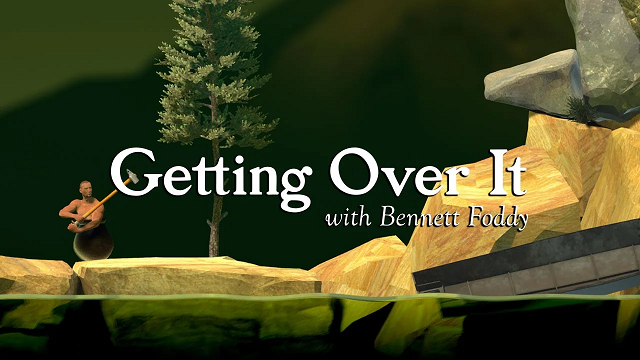
The most immediate challenge in GOI with Bennett Foddy is mastering the game's deliberately unwieldy physics. You navigate Diogenes, a man in a cauldron, using only a sledgehammer controlled by your mouse or trackpad. This setup demands extreme precision. Movements are not intuitive; a slight over-rotation or misjudged leverage can send you sliding backward. The complete lack of checkpoints magnifies every error. A single mistake at a great height can result in a soul-crushing fall, losing tens of minutes or even hours of progress in an instant, often back to a familiar early zone like the first set of rocks or the orange construction beams.
Beyond the physical controls, the psychological warfare is relentless. Bennett Foddy’s contemplative voiceover dissects your failures, the minimalist sound design amplifies every scrape and crash, and the sheer time loss from a major setback breeds profound frustration. Environmental hazards add layered difficulty. You will encounter slippery ice slopes that reject grip, awkwardly shaped furniture that requires perfect hooking angles, and seemingly impossible leaps like the infamous chimney ascent or the final telescope curve, each designed to test your technical and mental resolve.
How Can Beginners Master the Movement and Climbing Techniques?
1.The Foundation of Leverage and Pivoting
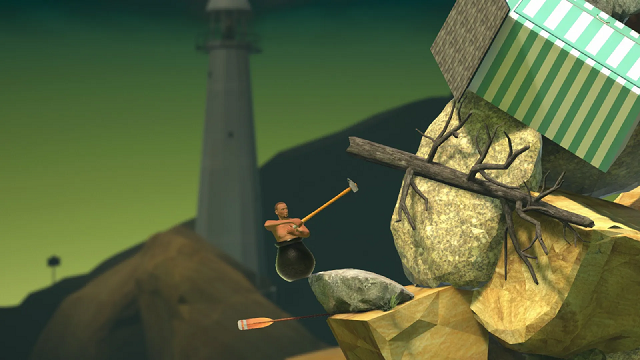
Everything in Getting Over It with Bennett Foddy It revolves around using your hammer as a lever. The contact point between the hammerhead and any surface is your pivot. Practice is essential. Spend time on safe, low ground learning to perform small "bunny hops" by clicking rapidly and making controlled swings for larger motions. Understanding how to swing around a pivot point to generate upward momentum, rather than just pulling directly up, is the first fundamental skill.
2.Mastering the Art of the Controlled Swing
Wild, large swings are often the cause of devastating falls. Beginners must learn the art of the short, controlled swing. This involves making tiny adjustments to your position by gently tapping and releasing the mouse button. It is the key to navigating tight corners, inching up vertical faces, and stabilizing after a near fall. Precision beats power. Before attempting a big move, always secure a stable position using these minute adjustments.
3.Learning Recovery and Fall Prevention
Falling is inevitable, but not every slip is a catastrophe. A critical technique is learning to catch yourself on edges as you slide down. As you fall, stay calm and try to hook the hammer on any protruding ledge or crack to arrest your descent. This skill turns a potential catastrophic drop into a minor setback. Practicing this reactive catching can save your climb countless times.
What Strategies Help You Reach the Top Successfully?
1.Embrace Incremental Progress and Segment Learning
Do not view the climb as one continuous journey. Break it down into memorable segments: the first rock quarry, the anvil, the orange hell, the ice, the city, and the final mountain. Master each section individually until you can traverse it consistently. This mental mapping makes the task less overwhelming and turns a massive challenge into a series of smaller, achievable goals. It also helps you mentally prepare for the specific techniques needed in each zone.

2.Prioritize Mental Resilience Over Mechanical Perfection
Your mindset is your most important tool. Accept that you will fall, often. When a major fall happens, instead of reacting with immediate anger, take a deliberate five to ten minute break. Stand up, walk away, and reset. This prevents tilt, the state of frustrated play that leads to compounding errors. Listen to Foddy’s narration not as mockery, but as philosophical commentary on the nature of struggle and perseverance.
3.Utilize External Resources Strategically
There is no shame in guidance. Watch skilled players navigate difficult sections on video platforms. Observe their exact mouse movements, their pacing, and the specific angles they use for troublesome jumps. However, do not just passively watch. Use these resources to understand the why behind a movement. Try to replicate the technique yourself in a controlled manner. This active learning accelerates your skill development far more than blind repetition.
The summit of Getting Over It is a trophy of personal perseverance. The journey, however, is paved with repeated failure that teaches resilience. While some seek to bypass the initial ownership process by looking for a Cheap GOI with Bennett Foddy Account, the true value of the experience remains in the raw, unfiltered struggle of the climb itself. The victory is not just in reaching the top, but in the countless lessons learned from each and every fall along the way.









SUPPORT
LEGAL
Policies






 USD ($)
 English
  Help Center