


Phantom Blade Zero


Phantom Blade Zero is a martial arts action RPG developed by S-GAME, combining fast-paced sword combat, challenging boss encounters, and exploration across a mysterious Wulin world. Released on October 29, 2026, for PlayStation 5 and PC, the game features more than 30 main weapons, 25 Phantom Edges, and multiple difficulty options designed for different skill levels. Players interested in exploring different account options can also Buy Phantom Blade Zero Account through marketplaces such as Z2U. For newcomers, understanding the combat system is more important than mastering complicated combos immediately. Learning when to parry, dodge, switch weapons, and manage combat resources can make difficult encounters considerably more manageable. This Phantom Blade Zero beginner's guide explains the essential combat mechanics, difficulty settings, weapon systems, equipment upgrades, exploration strategies, and common mistakes to avoid during your first playthrough.
Phantom Blade Zero Beginner Tips: Quick Overview
Before starting your adventure, here are the most important things every new player should understand.
| Beginner Priority | What You Should Know |
|---|---|
| Difficulty | Wayfarer offers a more accessible starting experience |
| Combat | Learn parrying and dodging before advanced combos |
| Sha-Chi | Manage combat resources instead of relying on constant blocking |
| Weapons | Experiment with main weapons and Phantom Edges |
| Weapon Switching | Can support resource management and combat flexibility |
| Equipment | Reforging allows previously invested upgrade materials to be recovered |
| Boss Fights | Study attack patterns before committing to long combinations |
| Exploration | Investigate side paths, NPCs, and optional activities |
These recommendations combine officially confirmed systems with observations from published gameplay previews. Certain resource interactions may differ in the release version.
Choose the Best Difficulty for Your First Playthrough
One of the first decisions players face in Phantom Blade Zero is selecting a difficulty level. S-GAME has explained that difficulty affects enemy behavior, not simply how much damage enemies deal. Higher settings can introduce more demanding combat situations and more adaptive opponents.
| Difficulty | Gameplay Focus | Best For |
|---|---|---|
| Wayfarer | More accessible combat and story progression | Beginners |
| Pathbreaker | Standard action-game challenge | Players with some experience |
| Hellwalker | More aggressive and adaptive enemy AI | Experienced action players |
| Sixty-Six Days | Special high-difficulty challenge | Players seeking an additional test |
Best difficulty for beginners: Wayfarer is the safest recommendation for players unfamiliar with precise parrying and dodging mechanics. Players who regularly enjoy challenging action games may prefer Pathbreaker. Hellwalker is better suited to those already comfortable reacting to complicated attack sequences. Sixty-Six Days is designed as an additional challenge, although its precise availability and rules should be checked in the final game.
Master Parrying and Dodging Before Advanced Attacks
Parrying and dodging are central to surviving difficult encounters in Phantom Blade Zero. Unlike games where players can rely primarily on repeated attacks, this combat system encourages observation, defensive timing, and calculated counterattacks. Developer interviews and gameplay previews describe color-coded warnings associated with different enemy attacks.
Blue indicators: Generally identify attacks that players can counter with correctly timed parries.
Red indicators: Warn of attacks that should be avoided through dodging rather than ordinary parrying.
Standard attacks: Require players to recognize enemy animations and choose an appropriate defensive response.
How to Practice Parrying Effectively?
Start with regular enemies rather than immediately attempting complicated boss encounters.
Observe the enemy's opening attack animation.
Wait until the attack approaches its impact point.
Attempt a correctly timed parry.
Watch the enemy's reaction and recovery animation.
Counterattack only when a safe opening appears.
Avoid repeatedly pressing the defensive button without watching the enemy. Precise timing is more reliable than random inputs. Combat Tip: If an enemy repeatedly defeats you, spend one attempt focusing entirely on learning its attacks rather than dealing maximum damage.
Understand How Sha-Chi Works
Sha-Chi is a combat resource described in pre-release gameplay reports. Its interactions with defensive actions, heavy attacks, and weapon switching encourage players to balance offense and defense.
| Combat Action | Reported Sha-Chi Interaction | Recommended Strategy |
|---|---|---|
| Blocking | Can consume Sha-Chi | Avoid prolonged passive defense |
| Successful Parry | Can reduce enemy combat resources | Practice defensive timing |
| Heavy Attack | May require Sha-Chi | Use during clear attack opportunities |
| Weapon Switching | Can restore Sha-Chi under certain conditions | Incorporate switching into combat |
| Perfect Dodge | Can create positional advantages | Use against dangerous attacks |
How to Manage Sha-Chi During Combat?
Beginners should avoid spending all available resources on powerful attacks. Instead, alternate between controlled offense, defensive reactions, and weapon switching when appropriate. This approach can help maintain flexibility during longer encounters, especially when enemies use multiple attack combinations.
Use Ghoststep to Improve Your Position
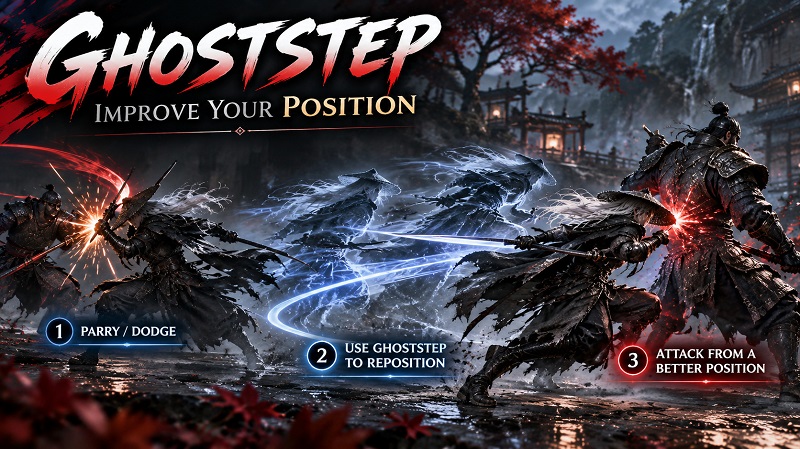
Ghoststep is a movement mechanic discussed in gameplay previews. Under certain conditions, successful defensive actions can create opportunities for Soul to move rapidly around an opponent and attack from a more advantageous position. This makes positioning an important part of combat strategy.
A practical approach is to:
Observe the enemy's attack pattern.
Respond with an appropriate parry or dodge.
Use an available Ghoststep opportunity to reposition.
Attack during the enemy's recovery animation.
Disengage before the next attack sequence begins.
Ghoststep should not be treated as an automatic response to every attack. Its effectiveness depends on timing, positioning, and the specific encounter.
Learn the Difference Between Main Weapons and Phantom Edges
Weapon variety is one of the defining features of Phantom Blade Zero. According to S-GAME, players can discover more than 30 main weapons and 25 secondary weapons called Phantom Edges. These options support different combat approaches and encourage experimentation.
| Weapon Category | Main Purpose | Beginner Recommendation |
|---|---|---|
| Main Weapons | Primary attacks and combat combinations | Master one or two weapons initially |
| Phantom Edges | Specialized attacks and additional abilities | Experiment with different effects |
| Ranged Options | Provide distance-based tactical choices | Consider when approaching enemies is risky |
| Support Abilities | Offer additional combat possibilities | Match abilities to encounter requirements |
Some secondary abilities can provide ranged attacks or summon assistance.
Which Weapons Should Beginners Use?
There is no sufficiently verified universal best weapon for every encounter. Instead of immediately searching for the highest-damage equipment, beginners should focus on weapons they can control consistently. Start with a familiar weapon, learn its attack rhythm, and gradually experiment with alternatives. Weapon switching may also support Sha-Chi recovery under certain conditions, according to gameplay previews.
Weapon Tip: A weapon that allows consistent defensive reactions may be more useful for a beginner than one with powerful but difficult combinations.
Use Reforging to Experiment With Equipment
Upgrading weapons is important for character progression, but beginners should avoid assuming that every early equipment choice is permanent. S-GAME has officially confirmed a Reforging system. This feature allows players to recover materials previously invested in upgraded weapons and redirect those resources toward different equipment. For example, a player who upgrades an early weapon can later recover those materials when deciding to use another weapon.
Equipment Upgrade Tips
Prioritize weapons that suit your preferred fighting style.
Test unfamiliar equipment before investing heavily.
Avoid upgrading too many weapons simultaneously.
Use Reforging when changing your primary equipment.
Consider different weapons for different enemy encounters.
The exact material requirements and upgrade costs should be checked in the final release. Reforging gives players more freedom to experiment without treating every upgrade decision as irreversible.
Follow a Simple Strategy for Difficult Boss Fights
Boss encounters are among the most demanding parts of Phantom Blade Zero. Gameplay previews emphasize varied attack combinations, defensive timing, and the importance of recognizing openings. Players who focus exclusively on dealing damage may struggle against enemies with complicated attack patterns.
Five Essential Boss-Fighting Tips
Observe before attacking. Identify the boss's most common opening combinations.
Recognize attack warnings. Decide whether an attack requires parrying or dodging.
Avoid excessive aggression. Use shorter combinations until you understand the enemy's recovery windows.
Experiment with equipment. Different weapons and Phantom Edges may provide useful tactical options.
Manage resources carefully. Preserve enough flexibility to respond to unexpected attacks.
Some gameplay previews describe particular checkpoint behavior during multi-phase boss encounters. However, these observations should not be assumed to apply universally.
Boss Tip: Treat difficult encounters as opportunities to learn enemy patterns. Understanding the timing of attacks is often more valuable than repeatedly attempting aggressive combinations.
Explore Side Paths and Talk to NPCs
Although combat is a major attraction, exploration also plays an important role in Phantom Blade Zero. S-GAME has described a Wulin world containing hidden locations, NPC interactions, and optional activities that can reveal additional narrative information. Players should therefore avoid rushing exclusively through main objectives.
What Should You Look for While Exploring?
NPC Conversations: Characters may reveal additional information about locations or optional objectives.
Side Quests: Optional activities can introduce additional story content.
Hidden Paths: Investigating alternative routes may reveal areas outside the main progression.
Environmental Details: Objects and written materials can provide additional context.
Checkpoints: Activate available recovery or travel points when exploring unfamiliar regions.
Published reviews have also discussed collectibles such as Memory Flowers and bells associated with exploration. However, their exact locations and functions should be verified through release-version gameplay.
Manage Healing Supplies and Upgrade Materials
Resource management is another important consideration for beginners. Some pre-release reports suggest that players cannot always rely on enemies automatically respawning after resting at checkpoints. This makes careful exploration and resource planning sensible strategies.
Before attempting a difficult area or boss encounter:
Check your available healing supplies.
Review your equipped weapons and abilities.
Upgrade equipment when appropriate.
Activate accessible checkpoints.
Explore nearby areas for optional resources.
Avoid spending all upgrade materials immediately.
Players should not assume that unlimited resource farming is available without confirming how enemy respawning works in the final game.
Avoid These Common Phantom Blade Zero Beginner Mistakes
Learning what not to do can be just as useful as understanding the game's mechanics.
| Common Mistake | Why It Causes Problems | Better Approach |
|---|---|---|
| Constantly attacking | Leaves Soul vulnerable to counterattacks | Learn enemy recovery windows |
| Ignoring attack indicators | Makes dangerous attacks harder to handle | Practice parrying and dodging |
| Using only one weapon | Limits tactical flexibility | Experiment with weapon combinations |
| Spending materials carelessly | Reduces short-term equipment options | Upgrade selectively and use Reforging |
| Skipping optional exploration | May cause players to miss additional content | Investigate side paths and NPCs |
| Choosing excessive difficulty | Can make learning unnecessarily frustrating | Start with a suitable challenge |
The most effective beginner strategy is to develop reliable defensive habits before attempting advanced offensive techniques.
Final Thoughts
Phantom Blade Zero rewards players who combine precise defensive timing with flexible weapon choices and thoughtful exploration. For beginners, the best approach is to choose an appropriate difficulty, practice parrying and dodging, learn how combat resources work, and gradually experiment with different weapons and Phantom Edges. Reforging provides additional freedom when upgrading equipment, while side quests and hidden locations offer reasons to explore beyond the main objectives. Rather than attempting to master every mechanic immediately, focus on consistent improvement. Understanding enemy attack patterns, managing resources, and adapting your equipment will help you approach increasingly difficult encounters with greater confidence. If you're ready to begin your own Wulin adventure, you can also explore Cheap Phantom Blade Zero CD Key offers on Z2U and compare available options before purchasing.









SUPPORT
LEGAL
Policies


 USD ($)
 English
 Help Center